
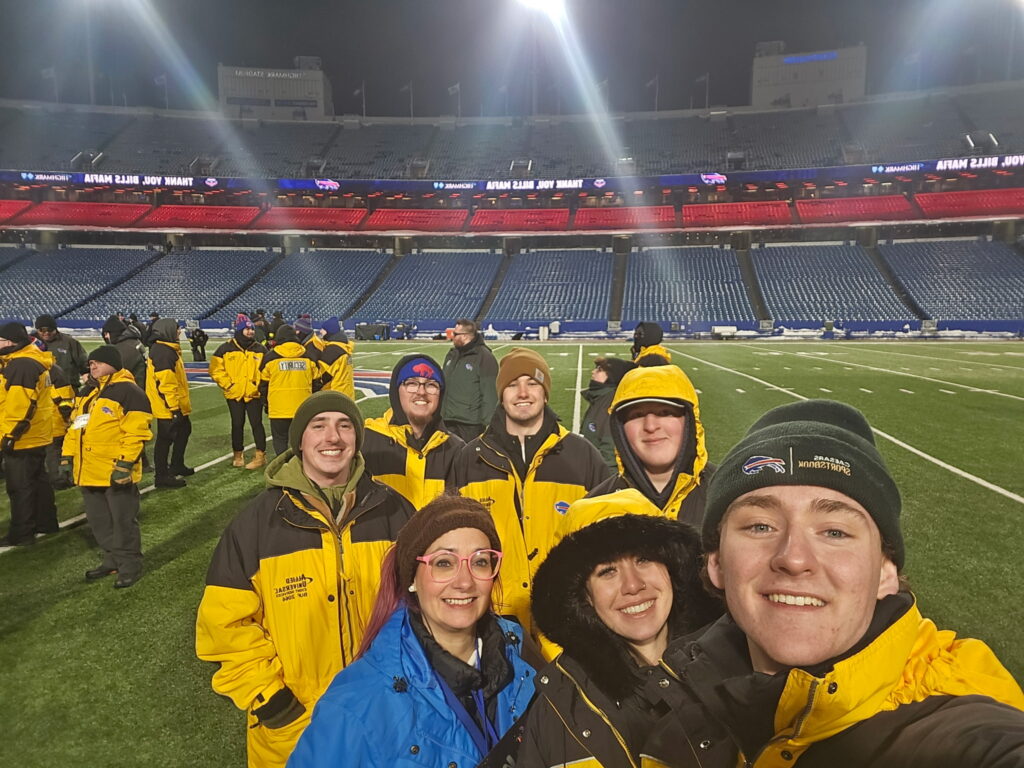
OLEAN, N.Y. — The wind whipped across the parking lots outside Highmark Stadium as Braxton Hall paced the stadium perimeter, scanning crowds of Buffalo Bills fans streaming toward the gates.
For hours, he monitored behavior, watched for conflicts and stayed alert in freezing temperatures.
It was exhausting — and exactly the kind of experience for which he had hoped.
“You can read about this kind of work in a classroom,” said Hall, a junior psychology and criminology major at St. Bonaventure University.
“But when you’re actually out there responsible for people’s safety, it becomes real in a way you just can’t learn from a textbook.”
Hall was one of dozens of St. Bonaventure students who worked Bills home games this season, collectively raising more than $13,000 to support campus organizations, conferences and professional opportunities.
For many students, the experience meant far more than fundraising. It meant stepping into real-world responsibility.
Long days and high stakes
Game days began hours before kickoff, with students arriving early to receive credentials and winter gear before beginning shifts that often lasted most of the day. Assignments varied widely.
Some students monitored crowds outside the stadium, while others assisted with security checkpoints or supervised sponsor areas.
Hall spent one game walking the perimeter, ensuring fans stayed safe and disputes did not escalate.
“You had to stay focused the entire time,” he said. “You couldn’t just zone out because something could happen at any moment.”
Another assignment placed him at a checkpoint screening equipment bags for NFL players entering the stadium.
“To see those players up close was incredible,” Hall said. “But you still had to stay professional and do your job.”
Kevin Eberth, a senior public health major, said the environment was unlike anything he had experienced.
“You’re part of this huge operation,” Eberth said. “There are thousands of people, and everything depends on teamwork and communication.”
Eberth helped monitor sponsor activations outside the stadium, ensuring crowds stayed orderly.
“You’re learning how to handle situations in real time,” he said. “It teaches you to stay calm, work with others and think quickly.”
Confidence and growth
Students said the biggest impact wasn’t physical endurance — it was personal growth.
Hall said the experience boosted his confidence.
“You’re dealing with people who can be intimidating,” he said. “But after doing it, I realized I could handle those situations.”
Eberth said working the games reinforced professionalism and teamwork.
“You have to stay aware the entire time,” he said. “If you miss something, it matters.”
He also said the shared experience built strong connections among student workers.
“You’re freezing, tired and working long hours, but everyone supports each other,” Eberth said. “That sense of community really stuck with me.”
Kyler Huels, a senior who participated through Alpha Phi Sigma — the national criminal justice honor society — said the opportunity was both demanding and rewarding.
“It was definitely a long day,” Huels said. “But you knew you were working toward something bigger than yourself.”
He said the experience strengthened communication skills and taught students how to interact professionally with fans and security staff.
“You learn how to talk to people, stay calm and handle pressure,” Huels said. “Those are skills you’ll use anywhere.”
Opening doors through fundraising
The money students earned helped fund professional conferences, travel opportunities and organizational initiatives.
Hall said the funds raised will support Alpha Phi Sigma’s upcoming national conference.
“That opportunity wouldn’t be possible for many of us without this fundraising,” he said.
Eberth said the Public Health Club also benefited, allowing more students to attend a statewide conference.
“Experiences like that can shape your career,” he said. “This helped make those opportunities accessible.”
Learning beyond the classroom
Dr. Tiffany Demiris, assistant professor of sports management in St. Bonaventure’s School of Business, said the program was designed to combine experiential learning with financial support for students.
“I wanted students to have opportunities they might not otherwise be able to afford,” Demiris said.
She said the most meaningful moments come when students apply classroom lessons in real-world settings.
“They start recognizing problems in real time and thinking critically about how to respond,” she said. “That’s when learning really comes alive.”
More than a job
Students said the experience left a lasting impression beyond the money raised. For Hall, it confirmed his interest in a future career in law enforcement.
“It showed me what it feels like to handle real responsibility,” he said.
Eberth said the experience taught him professionalism and teamwork.
“It wasn’t just about earning money,” he said. “It was about being part of something bigger and learning how to operate in the real world.”
As students look ahead to conferences, internships and careers, many say the long, cold days at Bills games were worth it.
“It was tough,” Hall said. “But it was one of the most valuable experiences I’ve had in college.”